The best portable tyre inflators 2026
We compare real portable inflators from MercadoLibre Argentina on airflow, auto shut-off and hose length, and explain why the 150 PSI almost all of them advertise means nothing for your car.
Prices verified on August 5, 2026 · How we do it
How we chose: We analyzed 15 real products on the market · MercadoLibre Argentina
As an affiliate, CompraGuide may earn a commission from qualifying purchases. It costs you nothing extra.
Quick verdict
The Xiaomi Mijia Air Compressor 2 wins for one concrete reason: it's the only one with a pressure regulator, so you set 35 PSI and it stops on its own. It weighs 490 g and moves 85 l/min. If budget rules, the Iael VA-037 costs less than half. And the Gadnic in304 is the best value on paper: the same airflow as the Xiaomi plus a 5-metre hose, which reaches all four wheels without moving the unit.
What to look for before buying
- Automatic pressure cut-off — This is the real difference between a convenient inflator and one that leaves you crouching next to a gauge. Models with a regulator let you dial in a target — 35 PSI, say — and switch off when they get there. Models without it keep inflating until you stop them, so you either watch or overshoot. Of the six here, the Xiaomi Mijia is the only one whose spec sheet declares a pressure regulator; the Stanley explicitly states it has none.
- Airflow, which is what sets how long you wait — Measured in litres per minute, this changes the experience far more than maximum pressure does. Across this list it ranges from 23 l/min to 85 l/min: almost four times the difference. At 85 l/min a car tyre that has lost some pressure tops up in a couple of minutes; at 23 l/min it's a long wait, and multiplied by four wheels it gets tedious.
- Own battery or the car's 12 V socket — Battery models don't depend on the car: you can take them to a bike, an air mattress or a motorbike, and the engine doesn't need to be running. The downside is runtime, which on a small inflator rarely covers four wheels from flat. The 12 V models plug into the cigarette lighter and run indefinitely, but they tie you to the car and you'll want the engine running so you don't drain the battery.
- Hose length — It sounds like a detail and it isn't. The Xiaomi comes with 20 cm: you have to hold the unit next to the valve, resting on the ground. The Gadnic in304 comes with 5 metres, so you leave it in one place and reach all four wheels without moving it. Neither is better in the abstract: the short one packs away smaller, the long one is more comfortable to use.
- Maximum pressure barely matters — Almost all of them advertise 150 PSI and it sounds like a lot. The catch is that a road car tyre runs at 30 to 35 PSI, meaning you use less than a quarter of what the device claims. That number only becomes relevant for road bicycle tyres, which do want 100 to 120 PSI. For cars, motorbikes, balls and inflatables, any of these is more than enough.
Our recommendations
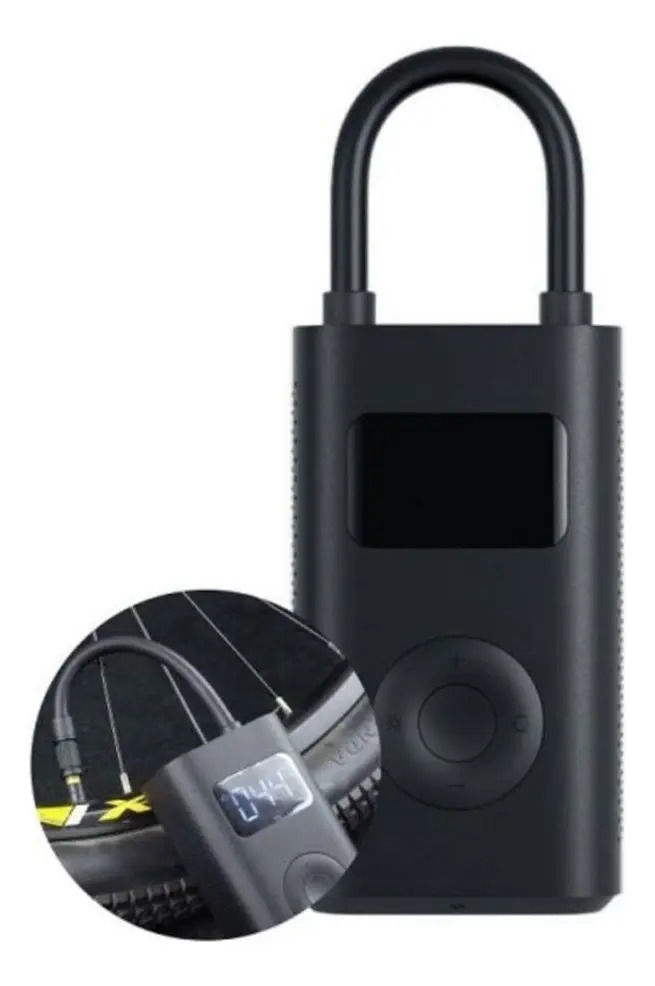
Xiaomi Mijia Air Compressor 2 MJCQB06QW portable electric compressor
The only one here whose spec sheet declares a pressure regulator: set the target and it cuts off by itself. It also brings 85 l/min of airflow and weighs 490 g, making it both the fastest and the lightest. The downside is the 20 cm hose: you have to hold it next to the valve.
Create price alert
Leave it empty to be alerted on any drop.

Iael VA-037 mini portable metal air compressor 150 psi
The cheapest of the comparison by a wide margin. It runs off the 12 V socket, has a metal body and a 1-metre hose. In exchange it's the second slowest on airflow (35 l/min) and declares neither a display nor automatic cut-off: you switch it off yourself.
Create price alert
Leave it empty to be alerted on any drop.

Gadnic in304 12V 150 PSI inflator with LCD display and LED torch
The best balance if you read the spec sheet: the same airflow as the Xiaomi (85 l/min) for considerably less, with 5 metres of hose to reach all four wheels without moving the unit, plus a gauge, a display and a torch. It weighs 1 kg and runs on 12 V.
Create price alert
Leave it empty to be alerted on any drop.

Gadnic 6000mAh portable electric compressor, digital display, 3 nozzles
The compact alternative with its own 6000 mAh battery: 598 g, a digital display and three nozzles for balls and inflatables. It declares 140 PSI, plenty for a car. It doesn't publish an airflow figure, so we can't tell you how long it takes.
Create price alert
Leave it empty to be alerted on any drop.

Stanley SXIF0001 mini portable air compressor with digital display
The best-known brand in the group, supplied with a bag and accessories. That said, its own spec sheet is worth reading: 23 l/min makes it the slowest here, and it explicitly declares no pressure regulator. You're paying for the brand and the backing, not the performance.
Create price alert
Leave it empty to be alerted on any drop.

Xiaomi Portable Electric Air Compressor 2 Pro
The Pro version of the Xiaomi, and the most expensive on the list. Same 149 PSI and a very compact body (15.2 × 10 × 6.3 cm) that fits in the glovebox. It only makes sense if minimum size and the brand matter to you more than the price gap against the standard Mijia.
Create price alert
Leave it empty to be alerted on any drop.
Side-by-side comparison
| Product | Price | Installments | Rating | Where |
|---|---|---|---|---|
| Xiaomi Mijia Air Compressor 2 MJCQB06QW portable electric compressor | $ 74.689 | — | — | MercadoLibre |
| Iael VA-037 mini portable metal air compressor 150 psi | $ 26.099 | — | — | MercadoLibre |
| Gadnic in304 12V 150 PSI inflator with LCD display and LED torch | $ 43.999 | — | — | MercadoLibre |
| Gadnic 6000mAh portable electric compressor, digital display, 3 nozzles | $ 69.999 | — | — | MercadoLibre |
| Stanley SXIF0001 mini portable air compressor with digital display | $ 87.999 | — | — | MercadoLibre |
| Xiaomi Portable Electric Air Compressor 2 Pro | $ 118.022 | — | — | MercadoLibre |
A portable inflator is one of those purchases that looks like an indulgence until the day it saves you. The good news is that the criteria for choosing one are short: almost everything these products advertise is irrelevant, and what actually changes the experience comes down to two or three figures that rarely appear in the title.
The 150 PSI is marketing
Practically every inflator on the market advertises 150 PSI of maximum pressure. It sounds impressive until you look at what your car needs:
A road car tyre runs between 30 and 35 PSI.
You’re using less than a quarter of what the device claims. That number only matters if you’re inflating road bicycle tyres, which do want 100 to 120 PSI. For cars, motorbikes, balls and air mattresses, anything on this list is plenty.
What is worth checking
- Automatic pressure cut-off. Dial in 35 PSI and it stops by itself. Without it, you’re watching the gauge so you don’t overshoot.
- Airflow (l/min). This is what sets how long you wait. Across this comparison it runs from 23 to 85 l/min: almost four times between slowest and fastest.
- Hose length. 20 cm forces you to hold the unit next to the valve; 5 metres lets you do all four wheels without moving it.
The correct pressure isn’t written on the tyre
This is the most common mistake. There is a pressure figure on the tyre sidewall, but that’s the maximum the tyre can take, not what your car needs.
The number you want is on a sticker in the driver’s door frame. It often specifies a different pressure for the front and rear axles, and another for when the car is loaded.
And check it cold: once you’ve been driving, the air heats up and expands, giving you a higher reading than the real one.
Our pick
The Xiaomi Mijia Air Compressor 2 wins on the pressure regulator, which is the difference between inflating a tyre and crouching there watching a number. It’s also the lightest, and it shares the highest airflow in the group.
That said, read the spec sheets cold and the Gadnic in304 is hard to argue with: the same airflow, a gauge, a torch and 5 metres of hose, for considerably less. What it lacks is the automatic cut-off.
An honest note on the Stanley: it’s the best-known brand here and the second most expensive after the Xiaomi Pro, but its own spec sheet declares the lowest airflow in the group and no pressure regulator. If you buy it, buy it for the brand’s backing and the accessory bag, not because it will inflate better.
Prices come from MercadoLibre Argentina and are updated every day.
Frequently asked
What pressure should my car's tyres be?
Don't decide it yourself and don't copy it from another car: it's printed on a sticker in the driver's door frame, and it's in the manual. It's usually between 30 and 35 PSI, and often specifies a different value for the front and rear axles, plus another for when the car is loaded or carrying passengers. That's the number to use — not the one written on the tyre sidewall, which is the maximum the tyre can take, not what your car needs.
Is 150 PSI actually useful?
Not for a car. A road tyre runs at around 35 PSI, so that figure is marketing: every inflator on the market comfortably exceeds what you need. Where it does matter is road bicycles, which want 100 to 120 PSI, and there it's worth checking that the device sustains that pressure rather than just advertising it. For cars, motorbikes, balls and air mattresses, anything on this list is plenty.
Battery or 12 V — which is better?
It depends what you want it for. If it's to keep in the boot and deal with a soft tyre now and then, the 12 V socket model is cheaper and never runs out of power, though you'll want the engine running so you don't drain the car battery. If you'll also use it for a bike, a motorbike, a ball or an air mattress, the battery model wins on convenience: you can take it anywhere. The downside of a battery is runtime, which at this size rarely covers four tyres from flat on one charge.
Do they overheat?
Yes, and it's the most common limitation in this category. These are small compressors with no cooling, designed for short cycles: topping up a tyre that has lost pressure, not inflating four from flat in one go. Run them for several minutes straight and they get quite hot, and many shut down on their own thermal protection. Living with it is simple: one wheel, a couple of minutes' pause, next wheel. If you regularly need to inflate tyres from flat, what you want isn't a portable inflator but a tank compressor.
How often should I check the pressure?
Once a month is a good rhythm, and always before a long trip. A tyre loses pressure on its own, with no puncture at all, by diffusion through the rubber, and it also drops when the ambient temperature falls. Check them cold — before driving, or after several hours parked: once you've been driving, the air heats up, expands and gives you a higher reading than the real one. Driving on low pressure burns more fuel, wears the tyre shoulders and lengthens your braking distance.
Are the prices and stock up to date?
Yes: we take real prices and availability from MercadoLibre Argentina and refresh them every day. They can change at any moment; the link always takes you to the current offer.
Related guides
Still unsure? Tell the assistant what you need and it'll recommend based on your budget.
Ask the assistant →